An introduction to intra group cash pooling arrangements
This post sets out general considerations for the legal implementation or review of intercompany agreements relating to one of the most common types of financial transactions – cash pooling arrangements.
It is important to have appropriate agreements and supporting documentation in place in advance to minimise risks of unnecessary transfer pricing challenges, as well as personal liability risks for legal entity directors.
Introduction
Awareness of the transfer pricing risks associated with financial transactions was raised by the OECD’s February 2020 report ‘Transfer Pricing Guidance on Financial Transactions: Inclusive Framework on BEPS: Actions 4, 8-10’. This is now incorporated into the 2022 edition of the OECD’s Transfer Pricing Guidelines. Tax litigation involving intragroup loans and guarantees has also motivated corporates to give more attention to the transfer pricing risks associated with these arrangements.
From a legal perspective, intercompany agreements arguably have a heightened role in relation to financial transactions, compared to other intercompany transaction types. This is for two main reasons.
Firstly, it is arguably impossible to delineate financial transactions through an analysis of the parties’ conduct alone. Fundamental terms such as repayment dates, interest rates (fixed or floating) and security or ranking cannot be deduced from observing the actions of the respective parties. One financial instrument cannot be compared with another for pricing purposes unless there is clarity on the associated legal rights and obligations of the respective parties in each case.
Secondly, from a legal entity perspective the corporate governance issues tend to be more transparent and immediate for financial transactions. For example, an intragroup lender necessarily incurs a credit risk in relation to the borrower’s ability to repay the loan. (This risk may or may not be economically significant for the lender, depending on whether or not the borrower is a subsidiary of the lender.) Similarly, a borrower may be exposed to liquidity risks relating to its ability to pay the interest arising on an intragroup loan when due, and to meet a demand for repayment of the loan.
It may be tempting to take a consolidated, group-wide view of financing arrangements. However, this would not meet the requirements of the arm’s length principle for transfer pricing purposes, or the legal duties of the directors of the respective entities. In the event that a member of the group (or the group as a whole) is subject to unforeseen liquidity issues, the legal control of individual legal entities may pass to trustees (in a bankruptcy) or other officers (in similar insolvency proceedings). Those officers may have a duty to consider potential claims against directors if those directors have failed to comply with their personal duties, such as those of safeguarding the entity’s employees and its creditors.
When considering the legal implementation of proposed intercompany financial transactions, it is therefore critical to consider the separate interests of each individual legal entity involved in the transaction. Although this review may take place centrally (for example, by the group’s tax, finance and legal functions), ultimately it is for the directors of each individual legal entity to approve.
Types of Cash Pooling
Cash pooling is a versatile cash management technique that enables companies and groups to optimise the use of their cash resources across multiple legal entities. By centralising or virtually consolidating cash balances, organisations can improve liquidity, reduce borrowing costs, and enhance overall financial efficiency. The two primary types of cash pooling arrangements are physical cash pooling and notional cash pooling, each offering distinct features and benefits.
Physical Cash Pooling
In a physical cash pooling arrangement, the actual movement of funds takes place between the bank accounts of participating companies. On a daily basis, surplus cash from the accounts of group companies is physically transferred to a central master account, often held by the parent company or a designated group treasury entity (often known as the ‘cash pool leader’). Conversely, if a participant has a cash deficit, funds are transferred from the master account to cover the shortfall. This process allows the group to consolidate its cash positions, minimise external borrowing, and maximize the return on cash surplus.
Physical cash pooling provides clear visibility and control over group-wide cash balances, making it easier to manage liquidity and allocate resources efficiently. However, it also introduces credit risk for participants, as individual companies become creditors or debtors to the master account holder. Legal documentation, such as a pooling agreement, is essential to define the rights and obligations of all parties, including terms for interest paid or received, repayment, and the allocation of any costs or benefits.
Notional Cash Pooling
Notional cash pooling, on the other hand, does not involve the physical transfer of funds between different accounts. Instead, the bank notionally combines the balances of all participating companies’ accounts to calculate a net balance for the group. Interest is then calculated on this net position, allowing the group to benefit from reduced interest charges on overdrafts or enhanced interest income on net positive balances, without moving physical cash.
This arrangement is particularly attractive for groups operating in multiple jurisdictions or with different currencies, as it avoids the complexities and potential tax issues associated with cross-border transfers of cash. Notional cash pooling relies heavily on the capabilities of the third party bank and the group’s treasury management system to track and report balances accurately. Legal agreements are still required to set out the terms of participation, including any cross-guarantees or liabilities among group companies.
Both physical and notional cash pooling arrangements offer significant benefits for cash management, but the choice between them depends on the group’s structure, regulatory environment, and strategic objectives. Careful consideration of the legal, tax, and operational implications is essential to ensure the arrangement delivers the intended benefits while managing associated risks. For further information on implementing or reviewing cash pooling agreements, consulting with legal and treasury experts is recommended.
Impact of the legal and regulatory environment
The 2022 OECD Transfer Pricing Guidelines recognise that the regulatory and legal environment within which the parties to an intercompany loan operate must be taken into account in assessing the transfer pricing analysis of the arrangements.
The economic conditions of loans should also be viewed in the context of regulations that may affect the position of the parties. For example, insolvency law in the jurisdiction of the borrower may provide that liabilities towards associated enterprises are subordinated to liabilities towards unrelated parties. (C.1.1.1, para 10.61)
Where the relevant MNEs are regulated, such as financial services entities subject to regulations consistent with recognized industry standards (e.g. Basel requirements), due regard should be had to the constraints those regulations impose on them. (B2, para 10.15)
The consideration of financial services regulations is outside the scope of this post. However, to the extent that they apply, their requirements as regards the form and content of intercompany agreements will in practice affect all other considerations, including transfer pricing.
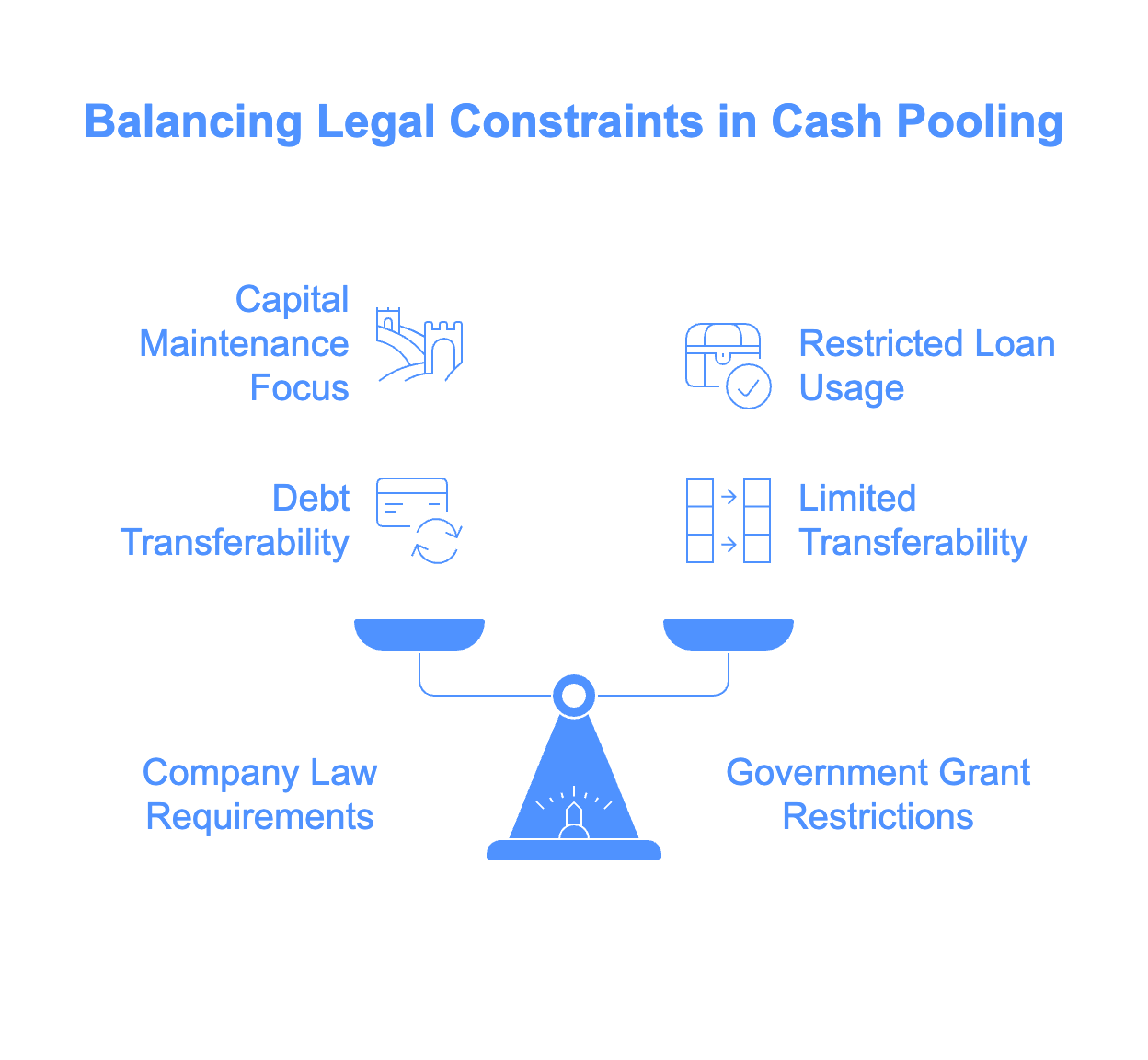
Aside from constraints affecting groups in the financial services sector, other legal considerations affecting the form and terms of intercompany debt may include:
- company law requirements regarding maintenance of capital or minimum paid-up capital
- legal restrictions attached to government grants and government-backed loans (for example Covid support) as regards how the proceeds of those grants or loans may be used. For example, this may mean that those proceeds cannot be used for the purpose of loans to, or cash pooling arrangements with, associated entities overseas
- requirements as regards the transferability and other terms of debt which is structured in loan note form if the relevant loan notes are to be listed on a stock exchange
Cash pooling regulations, legal requirements, and tax implications—including withholding tax—can vary significantly between countries. Multinational groups must consider the specific rules and compliance requirements in different countries when structuring cash pooling agreements, as these differences may impact the overall cash management strategy and tax efficiency.
Two-sided analysis and options realistically available to the parties
The OECD Transfer Pricing Guidelines requires a two-sided analysis of intercompany financial transactions. For example, it is stated that:
In considering the commercial and financial relations between the associated borrower and lender, and in an analysis of the economically relevant characteristics of the transaction, both the lender’s and borrower’s perspectives should be taken into account, acknowledging that these perspectives may not align in every case. (C.1.1.1 para 10.51)
This is closely related to the transfer pricing concept of ‘options realistically available to the parties’:
10.19. Independent enterprises, when considering whether to enter into a particular financial transaction, will consider all other options realistically available to them, and will only enter into the transaction if they see no alternative that offers a clearly more attractive opportunity to meet their commercial objectives (see paragraph 1.38 of Chapter I). In considering the options realistically available, the perspective of each of the parties to the transaction must be considered. (B.2 para 10.19)
These considerations have particular application to the borrower:
From the borrower’s perspective, the options realistically available will include broader considerations than the entity’s ability to service its debt, for example, the funds it actually needs to meet its operational requirements. In some instances, although an entity may have the capacity to borrow and service an additional amount of debt, it may choose not to do so to avoid placing negative pressure on its credit rating and increasing its cost of capital, and jeopardising its access to capital markets and its market reputation. (B.2 para 10.19)
The impact of these considerations is twofold.
Firstly, in many cases this form of analysis reinforces and aligns with the typical legal analysis of intercompany transactions. As discussed above, this legal analysis tends to emphasize the role of directors of as ‘custodians’ of the interests of the relevant legal entity of which they are director, irrespective of their roles as directors of related entities.
Secondly, it must be remembered that from a practical perspective, the assessment of options available to the parties and the two-sided transfer pricing analysis of transactions is likely to take place after the event. In many cases it will be a number of years after the event, when one or more of the relevant tax administrations raises enquiries, challenges or adverse assessments. The legal agreements and associated corporate approvals have a key role to play in documenting the commercial rationale for the arrangements from an entity-by-entity perspective.
Cash pooling: the legal implications
Although cash pooling arrangements often have important transfer pricing implications, the legal implications are arguably more immediate and more significant.
From a corporate governance perspective, directors of local legal entities are often personally accountable for breaches of duties to consider the interests of third party creditors and employees. In addition, provisions of local law regarding capital maintenance and banking regulation, as well as the terms of contractual arrangements with third parties (such as lenders or government bodies), may impose legal restrictions on the extent and manner in which local legal entities may properly participate in cash pooling arrangements.
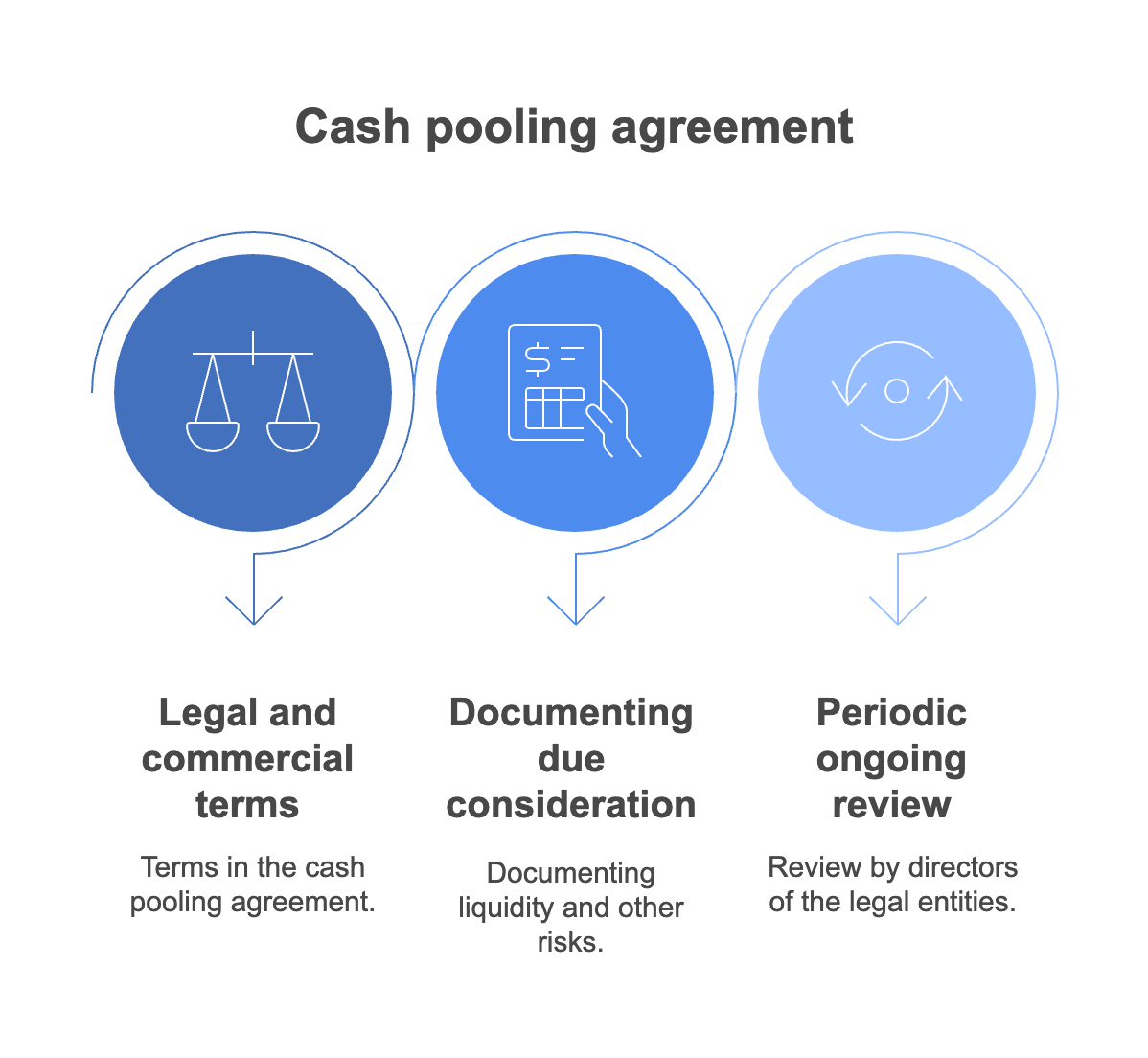
These local law considerations will need to be reflected in a number of aspects:
- the legal and commercial terms of the cash pooling agreement
- documenting the fact that liquidity and other risks have been given due consideration by legal entity directors, as part of the corporate approval process on the set-up of the cash pooling arrangements
- periodic, ongoing review by directors of the relevant legal entities of whether it remains appropriate for them to continue to participate
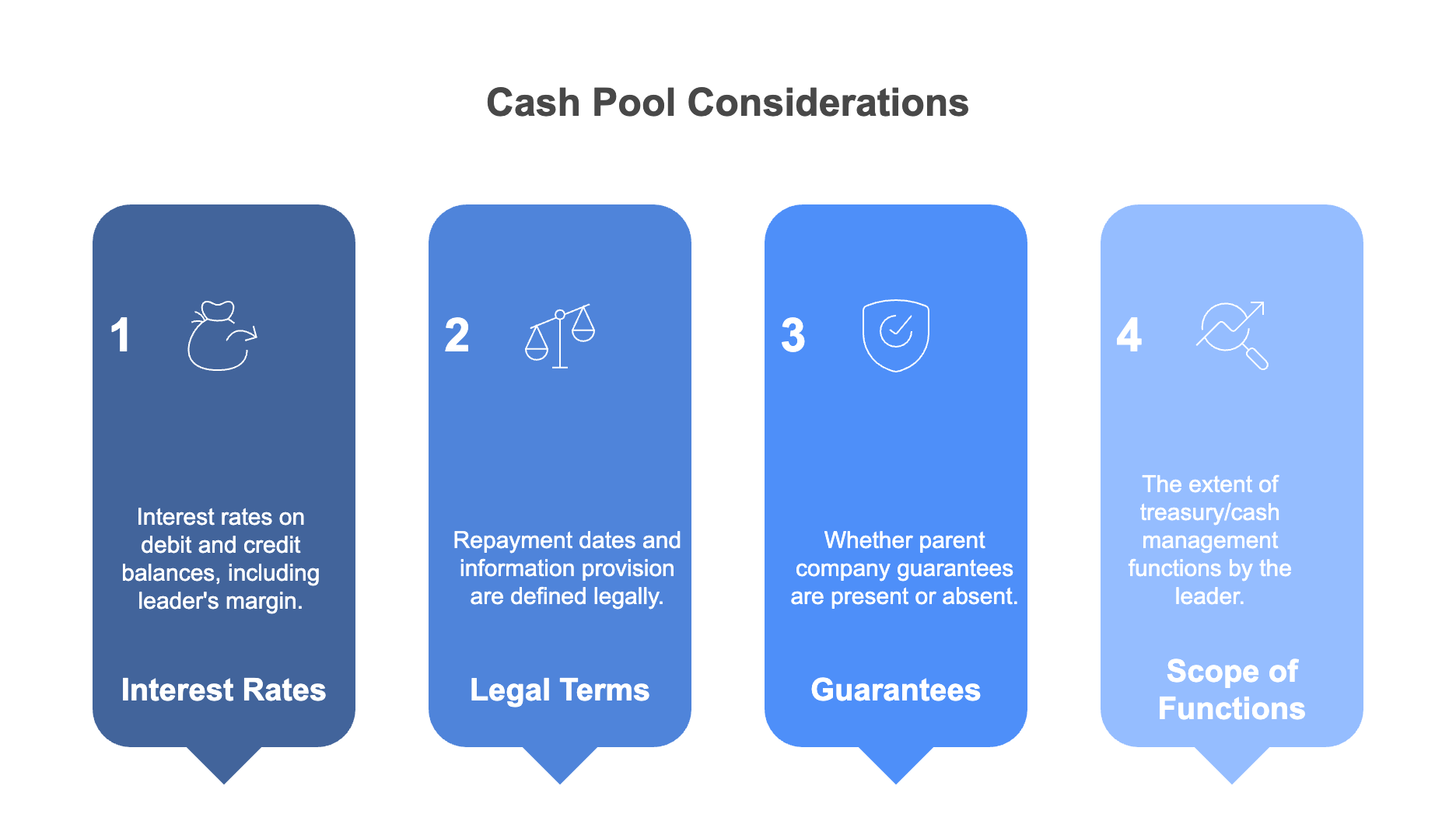
As for any other intercompany transaction type, the transfer pricing analysis needs to be aligned with the relevant legal terms, and vice versa. For practical steps in this process, see this 10-point checklist for reviewing intercompany agreements. This alignment will include, among other things:
- the interest rates payable on debit and credit balances (with the margin earned by the cash pool leader often constituting its primary compensation; the borrowing rate is used to determine interest savings and the allocation of benefits among participants)
- the legal terms regarding repayment dates and provision of information;
- the presence or absence of parent company guarantees
- the scope of the treasury or cash management functions performed by the cash pool leader
The legal documentation of notional cash pooling arrangements is often primarily provided by the relevant bank. These arrangements will often involve the provision of cross-guarantees by all of the cash pool participants. This results in similar liquidity risks as for physical cash pooling.
Whatever the form of cash pooling arrangements, the consideration to design, implementation and maintenance of the structure should be approached on a risk-based perspective. A primary consideration is to ensure that an appropriate paper trail is maintained so that directors can explain the positions they adopted, if challenged at a later point.
Practical steps for corporates when implementing cash pooling arrangements
Corporates and advisers should consider the following practical steps when designing and implementing cash pooling arrangements, in order to ensure they are as robust as possible and safeguard legal entity directors from personal liability risks:
- identify all the relevant stakeholders for the project. This includes not just transfer pricing, legal and regulatory input, but also legal entity directors, the treasury function, withholding taxes, the VAT treatment of payments and exchange control considerations
- carry out high level due diligence to identify the legal and commercial fact pattern. This should include (a) identifying any legal or regulatory restrictions on the ability of specific entities to participate in the proposed arrangements, (b) any legal or regulatory restrictions on the ‘free cash’ which may properly be contributed to the cash pool by specific entities, and (c) the impact of third party financing arrangements, cross-guarantees and security
- where needed, carry out supplementary, detailed due diligence on a risk-based perspective
- ensure that the proposed transfer pricing functional analysis is clearly understood and articulated, including as regards the functions performed and risks assumed by the cash pool leader
- give particular attention to the financial standing of the cash pool leader, and whether an express parent company guarantee should be provided for. This is a crucial consideration, since cash pool contributors are, in effect, giving up control over their own liquidity, and are relying on the financial covenant of the cash pool leader
- prepare an OECD-compliant draft intercompany agreement which clearly and unambiguously reflects the allocation / assumption of the relevant functions, risks and benefits of the cash pool, whilst also reflecting appropriate payment terms and information rights for participants
- finalise the pricing of the arrangements (including interest rates for credit and debit balances) by reference to the functional analysis and the legal terms as drafted
- arrange for the finalised agreement and associated documents to be signed and dated, including appropriate board briefings and approvals
- document appropriate systems for the regular review and updating of the arrangements. This is required not only for transfer pricing purpose, but also so that legal entity directors have a paper trail which demonstrates that they have appropriately considered liquidity risks and the interests of third party creditors, during the life of the arrangements
Free insights
Receive weekly practical insights on how to keep intercompany agreements and cross-border corporate structures tax-audit ready and transaction ready.