This is a guest post by Harold McClure, a New York City-based independent economist with 26 years of transfer pricing and valuation experience.
On September 10, 2024, the Poltava District Administrative Court ruled in favor of the taxpayer in Novo-Sanzharsky Grain Storage LLC v. State Tax Service (Case No. 440/3712/24). The litigation involved the intercompany price charged by this Ukrainian affiliate to a foreign affiliate.
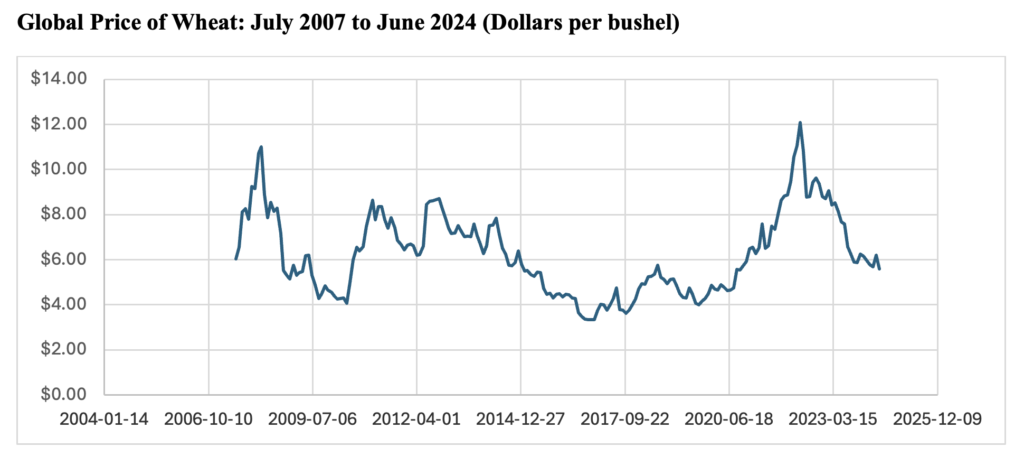
Before the Russian invasion of Ukraine, Ukraine produced 32.2 million metric tons of wheat per annum, which is equivalent to 1183 million bushels. The following figures shows one measure of the market price of wheat for the period from July 2007 to June 2024. This price averaged $6.25 per bushel over this 23-year period but also exhibited considerable variability. (Source: International Monetary Fund, Global price of Wheat [PWHEAMTUSDM], retrieved from FRED, Federal Reserve Bank of St. Louis.)
Poland’s State Tax Service (STS) asserted that the intercompany price for wheat sold by the Ukrainian affiliate was below the arm’s length standard over the 2014 to 2017 period. Its position and the rebuttals from the representatives of the taxpayer relied on applications of the Comparable Uncontrolled Price (CUP) approach that differed with respect to timing and transportation costs issues. The Administrative Court decision noted this criticism from the taxpayer with respect to the position of STS (defendant):
“STS compared prices in controlled transactions not on the date of pricing, but on the date of transfer of ownership of the goods, which is not in line with the established market practice. In addition, the defendant used incorrect data to make adjustments in order to achieve comparability with the conditions in the controlled transactions.”
Our discussion will address the timing issues as well as the role played by transportation costs.
Timing Issues and Forward Rate Contracts
Agricultural goods such as wheat are traded both on spot markets and forward markets. The prices noted in our figure represent spot prices. Menzie D. Chinn Olivier Coibion discuss the economics of commodity futures:
“This paper examines the relationship between spot and futures prices for a broad range of commodities, including energy, precious and base metals, and agricultural commodities. In particular, we examine whether futures prices are (1) an unbiased and/or (2) accurate predictor of subsequent spot prices … The notion that the futures price is the optimal forecast of the spot price is an implication of the efficient market hypothesis. In an efficient market, new information is reflected instantly in commodity prices. If this is true, then price patterns are random, and no system based on past market behavior can do other than break even. The link between efficiency and forecastability arises from realizing the difference between the current futures price and the future spot price represents both the forecasting error and the opportunity gain or loss realized from taking certain positions. The requirement that the forecasting error is zero on average is consistent with both market efficiency (the absence of profitable arbitrage opportunities) and the unbiasedness property of the forecaster (zero forecasting error on average).”
(Source: The Predictive Content of Commodity Future”, National Bureau of Economic Research, Working paper 15830, March 2010)
Forward and futures contracts are derivatives that involve two parties who agree to buy or sell a specific asset at a set price on a certain date in the future. Buyers and sellers can mitigate the risks of price changes by locking them in advance. Futures contracts are standardized to trade daily on exchanges. These arrangements come with fixed maturity dates and uniform terms.
Consider a situation where a wheat trading company negotiates with a wheat producer on January 15, 2015 for delivery of a certain order on April 15, 2015. While the spot price on January 15, 2015 was $5.30 per bushel, market participants were anticipating that wheat prices would decline over the next three months. The best case scenario for the seller would be a decline of only 2.83 percent lowering the spot price on April 15, 2015 to $5.15/bushel. The worst case scenario would be a decline of 8.5 percent to $4.85/bushel. The most likely scenario would be a decline of 5.66 percent to $5/bushel. The future price on January 15, 2015 for delivery in three months was $5/bushel reflecting the expected future spot price. Risk adverse producers might negotiate using the future price so that the wheat would be delivered at $5/bushel regardless of the spot price on the April 15, 2015 day of delivery. If the trading company sells the wheat on the spot market, then it would receive unexpected profits under the best case scenario but would incur unexpected losses under the worst case scenario. In our example, the spot price on April 15, 2015 happened to be $4.85 per bushel.
The Administrative Court decision provided only a few vague references to how the timing issues were addressed:
“In the case of a controlled transaction based on a forward or futures contract, price comparison shall be made on the basis of information on forward or futures prices as of the date closest to the date of conclusion of the respective forward or futures contract (provided that the taxpayer notifies the central executive body implementing tax and customs policy on the conclusion of such contract by means of electronic communication in electronic form in compliance with the requirements of the law on electronic document management and electronic digital signature).
Contrary to the above, LLC Novo-Sanzharsky Grain Storage did not report the conclusion of forward or futures contracts in 2017. During the audit, it was found that the Company in its reports for 2015-2017 indicated ‘supply’ transactions (transaction name code ‘026’) as the name of the transaction, while Annex 3 to the Procedure for Preparing the Report on Controlled Transactions No. 8 dated 18.01.2016 provides for the transaction name code ‘013’ for the forward contract.”
If the taxpayer had clear intercompany contracts based on future prices and if its transfer pricing policies were followed, then the intercompany contracts and policies should be respected as arm’s length. In our illustration, the intercompany price based on the futures price would be $5/bushel. If the taxpayer, however, used the April 15, 2015 spot price when it was below the corresponding future price then the tax authority would challenge the taxpayer’s approach. The converse is a valid potential criticism of the STS approach. In situations where the spot price was above the corresponding future price, it would not be appropriate to challenge an intercompany approach that respected the intercompany contract simply because market prices based on the spot marker reflect a lower price than the intercompany price that properly reflected the corresponding future price.
The STS relied on certain data from Argus Media, which is a respected provider of market data on various commodity markets. Argus Media presents both spot market prices for agricultural goods such as wheat as well as future prices. Simply because a tax authority relied on this data vendor does not mean that it properly used the market data in a meaningful way to evaluate the intercompany pricing issues.
Transportation Costs
Argus Media pricing data is described as “CFR”, which means that the seller must arrange and pay all costs to ship the product to a destination port. If the controlled transaction had the buyer pay for transportation, that is, is “free on board” (FOB), then a comparability difference is present with a need to adjust for the impact of transportation costs.
The Administrative Court noted:
“Argus Media LTD, during the analysis of which it was established that the information source contains prices for goods similar to the goods of the controlled transaction – corn of the 3rd class, wheat of the 2nd, 3rd classes and barley of the 3rd class. Given that the information source for 2015-2016 contains prices for corn, barley and wheat on FOB terms, which are not similar to the delivery terms under which the goods are delivered within the controlled transaction CPT, DAP Black Sea ports, the quotes published by Argus Media LTD for 2015-2016 are comparable to the controlled transactions after adjustment for delivery terms from FOB to CPT, DAP. Regarding the plaintiff’s arguments regarding the incorrectness of the controlling authority’s adjustment of the data of the information sources used to achieve comparability with the terms of the controlled transaction, in particular, the adjustment for delivery terms, the defendant’s representative noted that in order to adjust the terms and financial results of a controlled or uncontrolled transaction to avoid the impact of such differences on comparability, the controlling authority sent requests to stevedoring companies (terminals in seaports) to obtain information on the cost of complex cargoes. The information on the actual cost of transshipment was received from LLC JV Nibulon, LLC Grintur-Ex, LLC Borivazh. In addition, the supervisory authority used the research of the information and analytical agency UkrAgroConsult, SE Ukrpromvneshexpertiza, RBC-Ukraine (Business Format consulting company) on the transshipment markets for agricultural goods in Ukrainian ports in 2014-2018.”
Let’s consider the prices cited in our example represent CFR prices where the cost of transportation is included in our illustrations $5/bushel forward price. If the Ukrainian supplier affiliate was not responsible for shipping costs, then the evaluation of the arm’s length price must be on a FOB basis. In this case, the cost of transportation per bushel must be deducted from the $5/bushel forward price. If this cost represents $7.35 per metric ton or $0.20 per bushel, then the arm’s length price would be $4.80 per bushel. While the STS attempted to estimate transportation costs using third party contracts, it is not clear whether the data it used adequately captured the impact of transportation costs.
Concluding Remarks
The case of Novo-Sanzharsky Grain Storage LLC illustrates a basic point in transfer pricing theory and practice: as emphasized the 2023 update of the German Administrative Principles for Transfer Pricing, the relevant point in time for the application of the arm’s length principle is not the date when the relevant goods or services were supplied, but the date on which the relevant contract was concluded. Multinational groups that wish to reduce the risk of transfer pricing challenges would be wise to establish clear intercompany agreements which deal with the timing issues regarding the pricing of the relevant transactions. In the case of transactions involving commodities, those agreements should clearly specify whether prices are to be determined by reference to prices on the spot market versus forward contracts.
This case also demonstrates the impact of other contractual terms on pricing and comparability, such as those relating to delivery costs. Such terms should similarly be clearly set out in the relevant intercompany agreements and adjusted for accordingly.
Free insights
Receive weekly practical insights on how to keep intercompany agreements and cross-border corporate structures tax-audit ready and transaction ready.